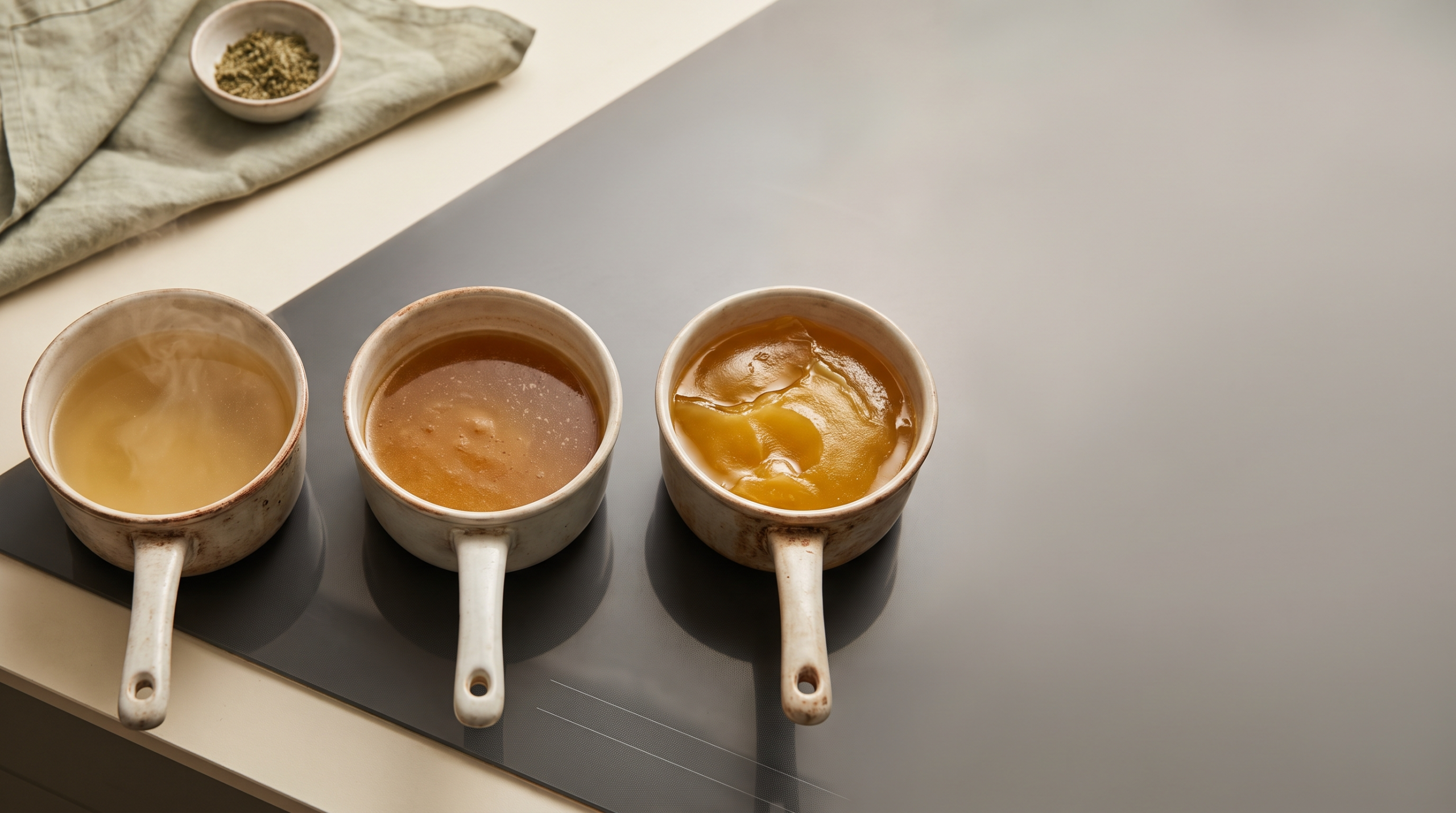
Bone broth is one of those foods that manages to sound ancient and trendy at the same time. Ask around and you will hear it is either a nutritional powerhouse or an overhyped cup of warm, salty water. The honest answer sits somewhere in between, and it is genuinely more interesting than either extreme. This is the plain-language, well-sourced version of what bone broth actually is, how it is made, what is really in it, and what the science does and does not say.
The Simple Definition
Bone broth is a savory liquid made by simmering animal bones and connective tissue in water, usually for a long time, often with a splash of vinegar and some vegetables or herbs for flavor. That long, slow cook does the important work: it draws collagen, minerals, and amino acids out of the bones and into the water. When a good bone broth cools, it often sets into a soft jelly, which is the clearest sign you have made real bone broth and not just a thin stock.
If you want the deeper detail on each part of the subject, this page is the front door. It links out to the full guides on the types of bone broth, its benefits, the forms it comes in, and how to use it.
Bone Broth vs. Stock vs. Broth
People use these three words interchangeably, and even chefs argue about the lines between them, but there is a real distinction, and it comes down to time and ingredients. As MD Anderson wellness dietitian Lindsey Wohlford explains, bone broth and the broths and stocks on grocery shelves are “similar but not the same.”
- Broth is the lightest and quickest. It is usually meat and vegetables simmered briefly into a thin, seasoned liquid.
- Stock uses bones and simmers a few hours for more body, and it is generally meant for cooking rather than sipping.
- Bone broth takes stock further, simmering bones and joints long enough, often a full day or more, to pull out real collagen and minerals. It is rich enough to sip on its own.
The easiest test at home is the jiggle: if it sets into a wobbly gel in the fridge, you have bone broth.
“Bone broth and other broths and stocks found at grocery stores are similar but not the same.”
Lindsey Wohlford, wellness dietitian, MD Anderson Cancer Center
How Bone Broth Is Made
The method is old and forgiving. Bones, often roasted first for a deeper, gently browned flavor, are covered with cold water and a splash of vinegar, which helps draw minerals from the bones. The pot is brought to the barest simmer and held there, skimmed now and then, until the liquid is rich and the bones have given up their collagen. Larger, marrow-rich bones and joints are prized because they carry the most collagen and gelatin.
Time is the other key ingredient, and it depends on the animal. A physician at the Mayo Clinic has noted that bone broth is often simmered anywhere from 24 to 72 hours, far longer than a quick stock. Beef bone broth rewards the longest cook, while fish bone broth is delicate and done in under an hour. For the full method and storage tips, see how to use bone broth.
What Is Actually in a Cup of Bone Broth
Here is where it gets interesting, and where a lot of the hype needs a reality check. The exact makeup of bone broth varies a great deal from one pot to the next, but most contain a recognizable set of components.
Collagen and Gelatin
Collagen is the headline. According to the U.S. National Institutes of Health, collagen is the most abundant structural protein in the human body, making up a large share of skin, bone, cartilage, tendons, and ligaments. Harvard’s Nutrition Source notes that in food, collagen is found only in animal parts that contain connective tissue, which is exactly what you simmer for bone broth. When that collagen is heated for hours, it breaks down into gelatin, the same substance that thickens the broth and gives it its set. Collagen is unusually rich in three amino acids, glycine, proline, and hydroxyproline, which is a big part of why broth comes up in conversations about skin, joints, and gut.
Amino Acids
As the collagen breaks apart, it releases amino acids your body can use, most notably glycine, proline, and glutamine. These are building blocks for your own connective tissue, and glycine in particular has been studied for a gentle role in sleep and relaxation.
Minerals and Electrolytes
Bone broth also carries minerals leached from the bones. Cleveland Clinic dietitians point out that it can supply calcium, magnesium, phosphorus, and potassium. One honest caveat: the amounts are usually modest and vary widely from batch to batch, so bone broth is better understood as a gentle contributor of these minerals than a rich source of them.
Protein
Because collagen is a protein, a cup of bone broth delivers a few grams of it, more than a plain broth. MD Anderson’s dietitians note that most of bone broth’s protein is collagen, the most common protein in the human body, and that a warm cup is an easy way to add protein, which is especially useful for anyone who needs gentle, sippable nutrition.
The most important honest note is about consistency. An independent analysis by researchers at the Australian Institute of Sport found that the collagen and amino acid content of bone broth varies dramatically, and is generally far lower and less predictable than a measured collagen supplement. In plain terms, your homemade pot and a store carton can be worlds apart, and no two cups are identical.
Why a Good Bone Broth Turns to Jelly
The wobble is not a gimmick, it is chemistry. Gelatin is simply collagen that has been broken down by heat and water. When a collagen-rich broth cools, the gelatin sets, which is why a proper bone broth jiggles like jelly straight from the fridge and melts back to liquid when you warm it. A broth that stays fully liquid when cold is still perfectly good to drink. It just did not extract as much collagen, usually because it had fewer joints and bones relative to water.
A Very Short History
Bone broth is not a modern invention. People have simmered bones into a nourishing liquid for as long as there have been pots and fire, in kitchens on nearly every continent, from the long-simmered stocks of Asian cooking to the pots of stock at the heart of French cuisine. What is genuinely new is the branding. The old, humble pot of stock got a wellness makeover and a new name, and became something people sip from a mug rather than only cook with.
What the Science Actually Says
This is the part most articles skip, and it is the most important. Bone broth is a genuinely nourishing food, but it is not magic, and the most credible experts say so plainly rather than overselling it.
The big question is whether eating collagen from broth actually rebuilds the collagen in your own skin and joints. The honest answer is that the evidence is still limited. Your digestive system breaks collagen down into amino acids like any other protein, and whether that meaningfully boosts your own collagen is not settled.
“There’s no downside to ingesting collagen, but there’s also no clear benefit.”
Dr. Denise Millstine, integrative medicine, Mayo Clinic
Clinical dietitians make a similar point about keeping expectations grounded. A dietitian at Cedars-Sinai has been candid that bone broth is not uniquely powerful compared with ordinary broth.
“There’s no evidence that bone broth has greater health benefits than any other broths.”
L.J. Amaral, clinical dietitian, Cedars-Sinai
So what is left once the hype is set aside? Quite a lot that is worth having. Bone broth is a warm, low-calorie, hydrating source of protein and a comforting daily ritual. Those are real benefits, even if they are unglamorous. The fair way to hold it is as good, nourishing food that may support a healthy routine, not as a treatment. Where the research on a specific claim is stronger, we say so across this site. For the full, honest rundown, see our guide to bone broth benefits.
Is Bone Broth Safe?
For most people, bone broth is a safe, everyday food. A few honest notes are still worth knowing:
- Sodium: store-bought broths can be high in salt, so check the label if you watch your sodium.
- Histamine: very long-simmered broth is higher in histamine, which can bother people who are sensitive to it.
- Heavy metals: a small 2013 study raised the question of lead leaching from bones into broth, while a later peer-reviewed analysis found the heavy-metal risk from bone broth to be minimal. Choosing quality, well-sourced bones is a sensible precaution.
If you are pregnant, nursing, managing a health condition, or feeding a baby, it is always worth a word with a qualified professional first. This page is information, not medical advice.
Frequently Asked Questions
Is bone broth the same as bouillon?
No. Bouillon is a concentrated, often heavily salted cube or paste meant to be diluted. Bone broth is a slow-simmered liquid valued for its collagen and body, and it is usually much lower in sodium.
Does bone broth have to gel?
A firm gel is a sign of plenty of dissolved collagen, but a broth that stays liquid when cold is still perfectly good. Gelling depends on the ratio of joints and bones to water.
Is bone broth just stock with a fancier name?
Not quite. It is a long-simmered, collagen-rich cousin of stock, cooked longer, often made with more joints and marrow bones, and usually sipped on its own rather than used only as a cooking base.
Does drinking collagen from bone broth boost my own collagen?
This is the claim to be careful with. Your body breaks the collagen down into amino acids during digestion, and the evidence that drinking broth rebuilds your own collagen is still limited. Enjoy it as nourishing food, not a guaranteed fix.
Is bone broth vegetarian?
No, by definition it is made from animal bones. A vegetable broth is the closest plant-based alternative, though it does not contain collagen.
Sources & References
Independent, third-party sources. No brand-funded or industry-commissioned studies are cited.
[1] Rahimi N, Launico MV. “Biochemistry, Collagen Synthesis.” StatPearls, NCBI Bookshelf, U.S. National Institutes of Health. www.ncbi.nlm.nih.gov/books/NBK507709/
[2] “Collagen.” The Nutrition Source, Harvard T.H. Chan School of Public Health. nutritionsource.hsph.harvard.edu/collagen/
[3] Alcock RD, Shaw GC, Burke LM. “Bone Broth Unlikely to Provide Reliable Concentrations of Collagen Precursors.” International Journal of Sport Nutrition and Exercise Metabolism, 2019. doi.org/10.1123/ijsnem.2018-0139
[4] “Bone Broth: Benefits, How To Make and Nutrition.” Cleveland Clinic. health.clevelandclinic.org/bone-broth-benefits
[5] “Is Bone Broth Good for You?” (Lindsey Wohlford, RD). The University of Texas MD Anderson Cancer Center. www.mdanderson.org/cancerwise/is-bone-broth-good-for-you.h00-159694389.html
[6] “Bone Broth: Is It Good for You?” (L.J. Amaral, RD). Cedars-Sinai. www.cedars-sinai.org/stories-and-insights/expert-advice/bone-broth
[7] “Is bone broth good for you? Experts explain” (Dr. Denise Millstine, Mayo Clinic). TODAY. www.today.com/health/diet-fitness/is-bone-broth-good-for-you-rcna134088
[8] Hsu D, et al. “Essential and toxic metals in animal bone broths.” U.S. National Library of Medicine (PMC5533136). www.ncbi.nlm.nih.gov/pmc/articles/PMC5533136
[9] Monro JA, Leon R, Puri BK. “The risk of lead contamination in bone broth diets.” Medical Hypotheses, 2013. www.sciencedirect.com/science/article/abs/pii/S0306987713000133