
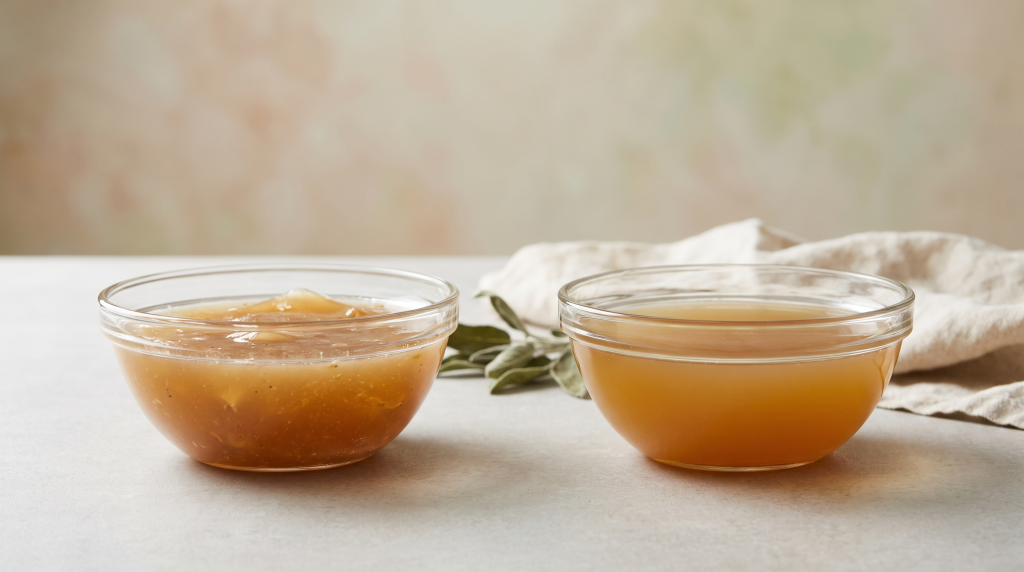
Quick Answer
- A broth that does not gel usually needs more collagen-rich bones, less water, or a longer simmer.
- Gel comes from collagen, so joints, knuckles, and feet are the bones that make broth set.
- A broth that stays liquid is still nutritious and good to drink; gel is a sign of richness, not a requirement.
- Small adjustments next time, more joints and less water, usually fix it.
You simmered your bone broth for hours, chilled it, and… it stayed liquid. If you were hoping for that satisfying, wobbly gel, this is a common and fixable disappointment. A broth that does not gel almost always comes down to a few simple factors, and once you understand them, you can fix it next time. Here is exactly why it happens and what to do.
First, reassurance: a broth that does not gel is not a failed broth. It is still nutritious, still flavorful, and still good to drink. The gel is a sign of a particularly collagen-rich broth, not a pass-or-fail test.
What the Gel Actually Is
The gel that forms when bone broth chills is dissolved collagen, which has broken down into gelatin during the long simmer. When the broth cools, that gelatin sets, giving the broth its wobble. So a firm gel simply means your broth extracted a lot of collagen, while a liquid broth means it extracted less. Understanding this makes the causes, and the fixes, obvious. For the fuller science, see our guide to does bone broth have collagen.
Reason 1: Not Enough Collagen-Rich Bones
This is the most common cause. Gelatin comes from collagen, which is concentrated in joints, knuckles, feet, and other connective tissue, not in plain, meaty, or marrow-only bones. If your broth was made mostly from bones low in connective tissue, there simply was not enough collagen to set. The fix is to include plenty of collagen-rich parts next time. Chicken feet and beef knuckles are especially good; our guide to the best bones for bone broth covers exactly what to choose.
Reason 2: Too Much Water
Even with good bones, too much water dilutes the collagen so much that the broth cannot gel. If you filled the pot generously with water relative to the bones, that is likely the culprit. The fix is to use less water, just enough to cover the bones by an inch or two, so the collagen is concentrated enough to set. If a finished broth is too thin, you can also simmer it down further to concentrate it.
Reason 3: Not Simmered Long Enough
Collagen takes time to break down into gelatin, so a simmer that was cut short may not have extracted enough. Beef in particular benefits from 18 to 24 hours, while chicken needs roughly 12 to 18. If your broth cooked for less, a longer, gentle simmer next time will help. A pressure cooker is the exception, extracting collagen quickly; see how to make bone broth in an Instant Pot.
Reason 4: The Simmer Was Too Hot, or Other Factors
A few other things can play a role. A very hard, rolling boil can affect the broth’s clarity and quality, so a gentle simmer is best. The bones themselves vary, and some batches are simply richer in collagen than others. A splash of vinegar in the water is traditional and may help draw collagen and minerals from the bones during the cook. None of these is usually the main cause, but together they can tip a borderline broth one way or the other.
How to Fix It Next Time
- Use more collagen-rich bones: knuckles, feet, and joints, alongside meaty bones.
- Use less water, just enough to cover the bones by an inch or two.
- Simmer longer and gently, especially for beef.
- Add a splash of vinegar to help draw out collagen and minerals.
- If a finished broth is thin, simmer it down to concentrate it.
Should You Even Worry About It?
Here is the honest perspective: gel is lovely and a sign of a rich, collagen-heavy broth, but it is not essential. A broth that stays liquid still contains collagen, protein, and minerals, still tastes good, and is still a nourishing cup or a fine cooking base. If you mainly drink your broth or use it in soups, a slightly lighter, non-gelling batch works perfectly well. So aim for the gel if you want maximum richness, but do not treat a liquid broth as a mistake.
Buying a Broth That Gels
If gelling matters to you and you would rather not troubleshoot a homemade batch, look for a quality store-bought broth known to gel, or choose a rich beef bone broth or a chicken bone broth made with feet. The protein number on the label is a good clue, since more protein usually means more collagen. Our guides to choosing a store-bought bone broth and the various forms of bone broth can help you find a consistently rich option.
The Gel Is Not a Pass-or-Fail Test
It is worth repeating, because it relieves a lot of needless worry: a broth that does not gel is still a good broth. The gel is simply a sign of an especially collagen rich batch, not a measure of whether your broth is nutritious or worthwhile. A liquid broth still contains collagen, protein, minerals, and flavor, and it works perfectly well for sipping or cooking. So if your batch stayed liquid, there is no need to pour it away or feel you failed. Adjust your method next time if you want a firmer set, but enjoy this batch in the meantime.
How to Concentrate a Thin Broth
If a finished broth is thinner than you would like, you can often improve it after the fact by simmering it down. Gently reducing the broth concentrates the collagen and flavor, which can coax a borderline batch toward gelling and certainly makes it richer. Keep the heat gentle to preserve clarity, and taste as you go, since reducing also concentrates the seasoning. This simple rescue is handy whether you are working with a homemade batch or even a thin store-bought broth you want to enrich.
Getting a Reliable Gel Next Time
For a firm gel in future batches, stack the odds in your favor: use plenty of collagen rich joints, knuckles, and feet, keep the water to just an inch or two above the bones, and simmer long and gentle, especially for beef. A beef bone broth built around knuckles and a chicken bone broth made with feet both gel beautifully. A splash of vinegar in the water helps draw out collagen too. If you would rather skip the trial and error, look for a quality store-bought bone broth known to gel, since the protein number is a good clue.
Don’t Let It Discourage You
It is easy to feel deflated when a batch you simmered for hours stays stubbornly liquid, but please do not let it put you off making broth. A non-gelling batch is still nutritious, flavorful, and perfectly good to drink or cook with, and even experienced cooks get the occasional liquid batch, since bones vary and the exact collagen content is never fully predictable.
The fixes are simple and reliable. Next time, lean on collagen-rich joints, knuckles, and feet, use less water so the collagen is concentrated, and simmer long and gentle, especially for a beef bone broth; a chicken bone broth made with feet gels beautifully too. A splash of vinegar in the water helps, and you can always reduce a thin finished broth to concentrate it. If you would rather skip the trial and error entirely, choosing a quality store-bought bone broth known to gel is a perfectly good option, and the protein number on the label is your best clue to its richness.
The Bottom Line
To pull it together, a broth that does not gel simply extracted less collagen, usually because it needed more collagen-rich bones, less water, or a longer simmer, and it is still a perfectly nutritious, flavorful broth. Aim for the gel if you want maximum richness, using joints, knuckles, and feet, less water, and a long, gentle cook, but do not treat a liquid batch as a failure. If you would rather not troubleshoot, a quality store-bought bone broth known to gel is an easy option, and the protein number on the label is your best clue to how rich it is.
Frequently Asked Questions
Why didn’t my bone broth gel?
Usually it needed more collagen-rich bones like knuckles and feet, less water, or a longer simmer. Gel comes from collagen, so a liquid broth simply extracted less of it.
Is bone broth still good if it doesn’t gel?
Yes. A broth that stays liquid is still nutritious, flavorful, and good to drink or cook with. The gel is a sign of a particularly collagen-rich broth, not a requirement.
What bones make bone broth gel?
Collagen-rich parts like knuckles, feet, and other joints are what make a broth set. Chicken feet and beef knuckles are especially good for a firm gel.
Can I fix bone broth that didn’t gel?
You can improve a thin finished broth by simmering it down to concentrate it. For next time, use more collagen-rich bones, less water, and a longer, gentle simmer.
Does store-bought bone broth gel?
Quality ones often do. Look for a broth known to gel or one with a higher protein number, since more protein usually means more collagen and a firmer set.
